
It’s been a while since I wrote about Backyard Operations. There’s a reason for that.
I got bored.
When I started Backyard Operations, I had all kinds of ideas. I was going to track egg production. Monitor the soil in my garden. Keep an eye on the temperature in the chicken coop. Build automations for backyard tasks. Create dashboards. Connect sensors. Collect data. Basically, if something in my backyard could generate data, I wanted it in Salesforce.
It was going to be my tiny backyard technology lab.
And for a while, it was fun. I built the data model. I started collecting information. I connected things. I made plans for all the interesting things I could eventually do with that data.
Then I actually had some data.
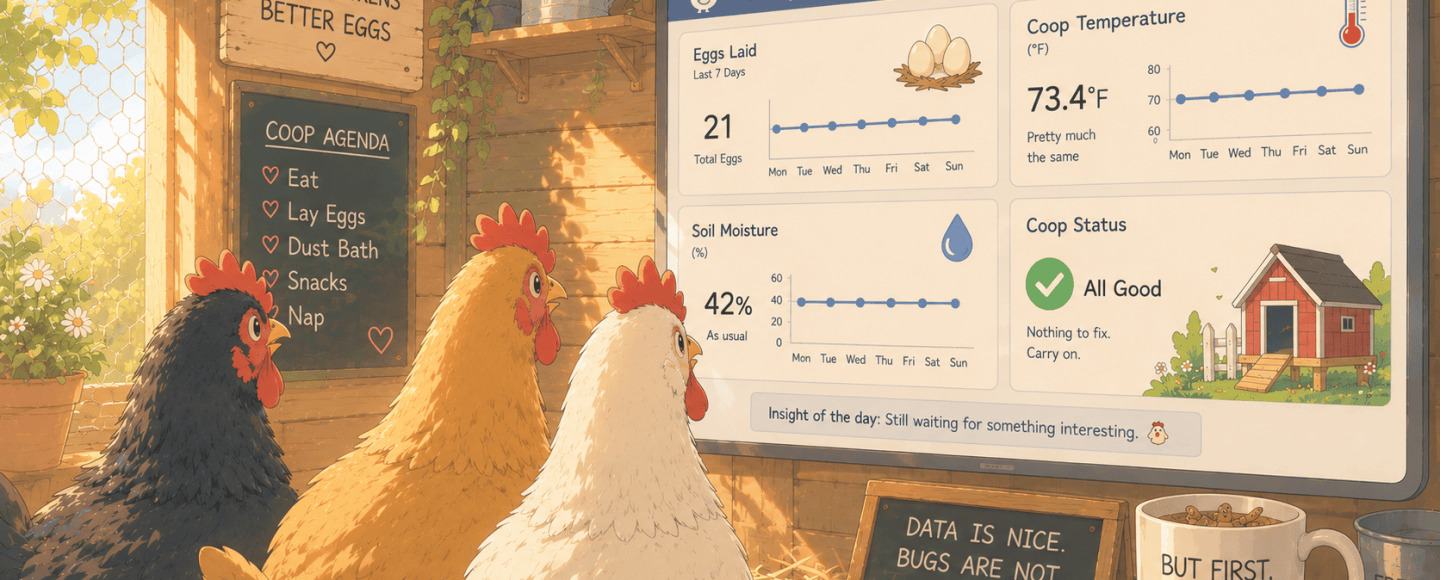
My three chickens laid about three eggs every day. The next day, they laid three eggs. And the next day? Three eggs.
My soil monitor wasn’t much more exciting. The readings were remarkably consistent. The temperature in the coop wasn’t uncovering some fascinating pattern I needed to respond to either. Basically, everyday it told me it was hot and the fan needed to be on.
Everything was working.
That was the problem.
I Had Data. I Didn’t Have a Question.
Somewhere along the way, I realized I had designed Backyard Operations exactly backwards. I hadn’t started with a problem. I started with all the things I could do.
I could track eggs. I could collect sensor data. I could create dashboards. I could automate tasks. I could put all of it in Salesforce. So I did what we sometimes see happen in technology projects: I built the solution first and waited for the problem to show up.
It never did.
There was nothing wrong with the data. It was accurate. There was nothing wrong with the technology. It worked exactly the way I designed it. The problem was that none of it was helping me make a decision.
If my chickens laid three eggs yesterday and three eggs today, what was I supposed to do differently?
Nothing.
If the temperature in the coop was exactly where I expected it to be, what action did that trigger?
Nothing.
I had built a system that was very good at telling me things I already knew.
I Became the Person Asking for a Dashboard
This realization made me laugh because I had basically become my own stakeholder.
You know the conversation. Someone says, “I need a dashboard.” Okay. What do you want to know? “I want to see the data.” Okay. And once you see it, what decision are you going to make?
…
That’s the question I hadn’t asked myself.
I wanted a dashboard because dashboards are cool. I wanted sensors because connecting physical things to Salesforce sounded fun. I wanted automations because I could build them. But I hadn’t stopped to ask what pain point any of it was solving.
I had planned the whole thing backwards.
Instead of:
Pain Point → Question → Information Needed → Solution
I had done something closer to:
Cool Technology → Data I Could Collect → Dashboard → Wait for Something Interesting to Happen
And nothing particularly interesting happened.
A Dashboard Nobody Uses Isn’t Necessarily a Bad Dashboard
Eventually, I stopped checking.
That might actually be the most important part of this whole experiment. The dashboard didn’t become less accurate. The integrations didn’t stop working. The data didn’t suddenly become bad.
I just didn’t care anymore because there was nothing actionable there.
And isn’t that exactly what happens to so many dashboards?
Someone asks for one. We spend time figuring out the fields, building the reports, choosing the charts, arranging everything nicely, and making sure the data refreshes correctly. Everyone looks at it when it launches. Then a few weeks go by. Then a few months. Eventually, nobody remembers the link.
Sometimes we assume that means the dashboard wasn’t good enough. Maybe it needed better charts. Maybe we should add another metric. Maybe it needs to be on the homepage.
But sometimes the dashboard is perfectly fine. It’s just telling the wrong story.
If the information doesn’t help someone recognize a problem, make a decision, change a behavior, or take an action, why would they keep looking at it?
My chickens didn’t need a better dashboard.
They didn’t need a dashboard at all.
And About Those Tasks…
I also had plans for backyard task management: feeding chickens, watering plants, cleaning things, whatever other recurring jobs inevitably appear when you have a backyard full of living things.
Could I build a custom object in Salesforce for that? Absolutely. Could I add statuses and due dates and recurring automation and notifications and maybe a Flow or two? Absolutely.
Do you know what’s actually better for reminding me to do something in my backyard?
Google Calendar.
That’s where the rest of my life already is. It reminds me when I need to do something. I check it every day. It requires approximately zero architecture.
Salesforce doesn’t have to win every time. Sometimes the right solution is the boring solution that already works.
Maybe Backyard Operations Wasn’t a Failure After All
For a while, I think I stopped writing about Backyard Operations because it felt like I had run out of things to build. Looking at it now, I think I was measuring the experiment the wrong way.
The interesting part wasn’t whether I could track chickens, connect sensors, or build a backyard dashboard. I already knew I could do those things.
The interesting part was discovering what happened after I built them.
Nothing.
And that’s actually a pretty useful architecture lesson.
Technology doesn’t create a use case. Data doesn’t automatically create insight. A dashboard doesn’t automatically create action. And building something simply because we can is very different from building something because somebody needs it.
So I’m changing the way I think about Backyard Operations. I’m not going to sit around trying to invent the next Salesforce feature my chickens might need.
I’m going to wait.
Maybe a problem will show up. Maybe one of the chickens will stop laying eggs. Maybe something in the garden will start behaving strangely. Maybe I’ll eventually find myself repeatedly doing something annoying and think, there has to be a better way to do this.
And when that happens, I’ll have something much more useful than an idea for a cool technology.
I’ll have a problem worth solving.
Until then, the chickens are doing just fine without their dashboard.


0 comments on “Backyard Operations: My Chickens Didn’t Need a Dashboard”